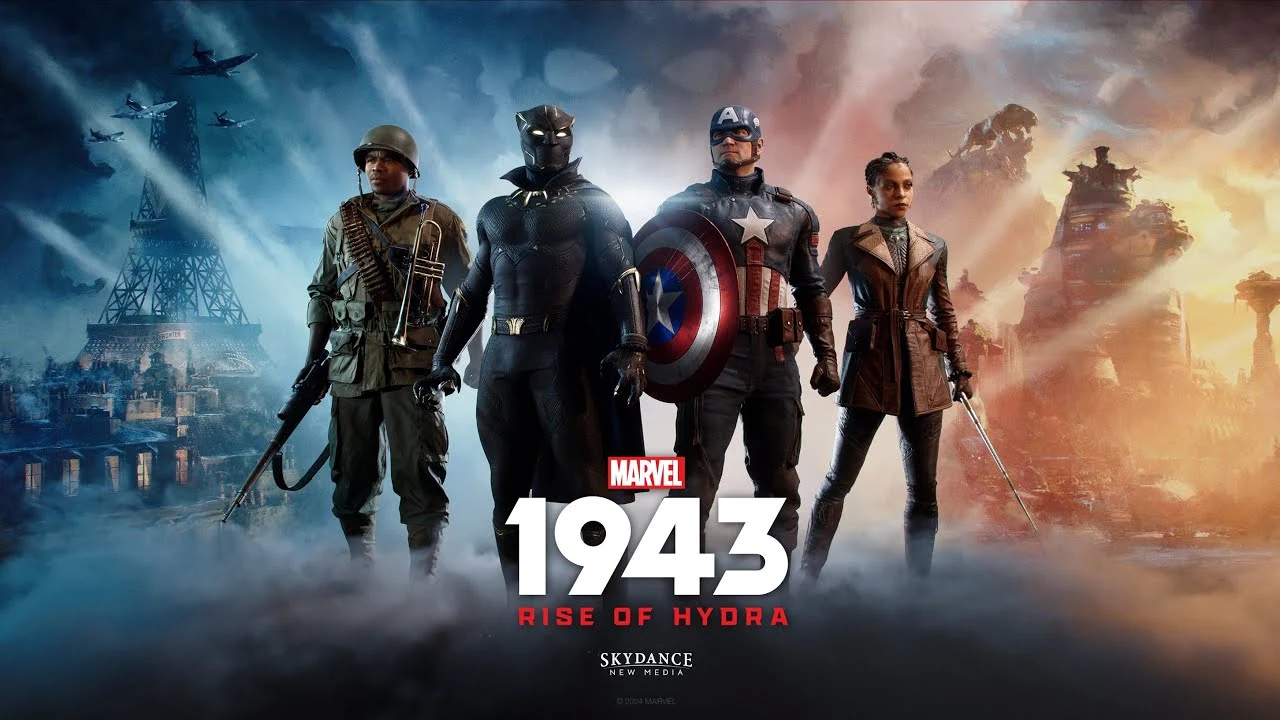
- The Marvel 1943 Rise of Hydra tech demo showcases Unreal Engine 5.4 running entirely in real time
- Nanite adaptive tessellation displaces simple geometry into rich 3D detail with memory efficiency
- MetaHuman Animator faithfully transfers actor performances, including the Black Panther facial scenes
- Heterogeneous volumes replace particle sprites with film-quality volumetric smoke and fire
- The demo is set in 1940s occupied Paris, with Captain America and a new Black Panther clashing on a bridge
Tech Demo Overview: Occupied Paris in Real Time
The Marvel 1943 Rise of Hydra tech demo is a real-time Unreal Engine 5.4 showcase set in a harsh winter in 1940s occupied Paris. It features Steve Rogers' Captain America facing off against Azzuri, the era's Black Panther, on a snow-dusted bridge while German forces comb the streets below. The developers emphasized that believable characters must live inside equally convincing environments, which is why every prop, rooftop, and patch of dirt in the demo is built with authentic, densely layered detail.
Video Highlights:
- Full bridge confrontation between Captain America and Black Panther running in real time
- German soldiers searching Paris house to house while heroes clash above
- Ground-level adaptive tessellation revealed from a few hundred triangles
- Snow accumulation dialed up and down dynamically on environmental props
- Volumetric smoke from a fire barrel dynamically lit and casting shadows
The demo's most striking claim is that the entire cinematic sequence—including close-up facial performances with the Black Panther's mask off—runs entirely in real time, not as a pre-rendered cutscene. The setting grounds the story's tone: gritty, cold, and occupied, with the Eye of Force subplot driving heroes with competing agendas into the same city.
When watching the demo, switch your attention between the characters and the ground. The tessellated dirt, snow, and debris underfoot is real generated geometry, not a flat texture trick.
Nanite Adaptive Tessellation Explained
The headline feature of the demo is Nanite's new adaptive tessellation in Unreal Engine 5.4. The team stripped the bridge environment down to a bare ground plane—a relatively simple mesh of just a few hundred triangles—to reveal how the system works.
| Stage | What You See | Triangle Count |
|---|---|---|
| Base mesh | Simple flat ground plane | A few hundred |
| Tessellation applied | Displaced 3D geometry, dirt, cracks, ruts | Nanite-level density |
| Tile textures layered | Complex surface effects via shader logic | No extra authored meshes |
| Runtime changes | Footprints, tire tracks, supernatural effects | Dynamic, memory-efficient |
The key advantage is memory efficiency. Building this complexity across a huge level with traditional instancing would be impractical, but layered tile textures plus shader logic displace the simple geometry into the detail quality players expect from Nanite—without crazy amounts of authored geometry.
The same technique applies to every object in the environment, not just terrain. The demo flies to a pile of props near the watchtower and dials snow accumulation up and down at will, blanketing every rooftop and object realistically for the occupied-Paris winter setting.
Because tessellated detail can change dynamically at runtime, the environment can record gameplay: footprints, tracks, and even story-driven effects can appear as actual geometry during play.
This approach also empowers art direction. Artists build the environment as a series of layers and stack complexity layer by layer, letting even a small team set dress and art direct scenes dynamically rather than hand-authoring every prop variant.
Heterogeneous Volumes and Volumetric Effects
Traditional smoke and fire in games rely on particle sprites—flat, camera-facing cards that often break down and look flat up close. The demo replaces this with heterogeneous volumes for genuinely three-dimensional, film-quality volumetric effects.
| Feature | Old Approach (Sprites) | Heterogeneous Volumes |
|---|---|---|
| Smoke rendering | Flat billboarded cards | True 3D volume |
| Lighting response | Limited, often fake | Dynamic light transmission through volume |
| Shadows | Rarely self-shadowed | Smoke casts shadows on world and itself |
| Mixing | Separate systems | Unified with particles and cards |
| Simulation | Pre-baked or simple | Runs natively in UE or via OpenVDB import |
The showcase scene is a fire barrel by the watchtower: a light illuminates the smoke rising from it, the fire's glow transmits dynamically through the volumetric smoke, and the smoke itself casts shadows onto the surrounding world and onto itself. Sparse volume textures imported from OpenVDB datasets allow film-quality visual effects that are fully responsive to dynamic lighting and run in real time.
Volumetrics mix with traditional effects—particles and cards still work inside fog—so teams can blend old and new techniques in a single unified system.
MetaHuman Characters and ML Cloth Simulation
Characters anchor the demo, and two systems make them believable. First, Captain America's leather uniform fits and creases exactly as real leather would. The team runs complex cloth simulations in Houdini, imports the data into Unreal Engine, and trains a machine learning model on it—producing film-quality deformations that run in real time.
Second, facial performances come through the MetaHuman pipeline. The demo replays the bridge confrontation with Azzuri's mask off to showcase untouched MetaHuman Animator solves, preserving every nuance of the actors' performances. The cast includes Drew Moerlein as Captain America and Kelsey Payton as the Black Panther.
ML Cloth Deformation
- Houdini simulation data trains an ML model
- Film-quality leather creases in real time
- Material properties match real-world behavior
MetaHuman Animator
- Untouched facial performance solves
- Preserves every actor nuance
- Runs fully in real time
Character Pairing
- Captain America vs. Azzuri's Black Panther
- Competing agendas in occupied Paris
- Vibranium-cutting claws vs. the shield
The bridge dialogue itself sells the rivalry: Azzuri calls out the star-spangled hero for hiding behind a shield he considers him unworthy of, while Cap retorts at the "man dressed like an overgrown house cat."
The tech demo demonstrates engine capabilities and story tone. Exact feature implementation in the released game may differ, so treat specific techniques as showcases rather than guaranteed final-game specs.
How to Analyze the Demo Yourself
Watch the Bridge Scene First
View the full confrontation with the mask on to judge the cinematic pacing, voice performances, and staging before diving into the technical breakdown.
Focus on the Ground Geometry
Note how the demo strips the scene down to a few hundred triangles, then re-applies tessellation to show where the dirt and debris detail actually comes from.
Track the Snow Controls
Watch the snow accumulation dial up and down on props near the watchtower—proof the effect is dynamic geometry, not baked textures.
Study the Fire Barrel Volumes
Observe light transmission and self-shadowing in the volumetric smoke, the clearest sign of heterogeneous volumes at work.
Replay the Mask-Off Finale
Watch the closing scene with Azzuri unmasked to evaluate MetaHuman facial fidelity and ML cloth deformation in motion.
Demo Analysis Checklist:
- Confirm the entire sequence runs in real time
- Identify adaptive tessellation in the ground and props
- Spot dynamic snow accumulation controls
- Check volumetric smoke for self-shadowing
- Compare masked vs. unmasked facial performance
- Evaluate leather cloth creasing on Captain America
FAQ
Q: Is the Marvel 1943 Rise of Hydra tech demo pre-rendered?
No. The developers explicitly state that the entire bridge scene, including close-up facial performances with the mask off, runs entirely in real time in Unreal Engine 5.4.
Q: What is adaptive tessellation in the demo?
It is a Nanite feature that displaces simple geometry (a ground plane of a few hundred triangles) into detailed 3D surfaces using layered tile textures and shader logic, keeping memory use practical while allowing runtime changes like footprints and tire tracks.
Q: Who plays Captain America and Black Panther in the demo?
Drew Moerlein plays Captain America, and Kelsey Payton plays the Black Panther, Azzuri. Their performances are preserved through the MetaHuman Animator pipeline.
Q: Where and when is the demo set?
The demo takes place during a harsh winter in 1940s occupied Paris, with German soldiers searching the city while Captain America and the Black Panther clash over the mysterious Eye of Force.