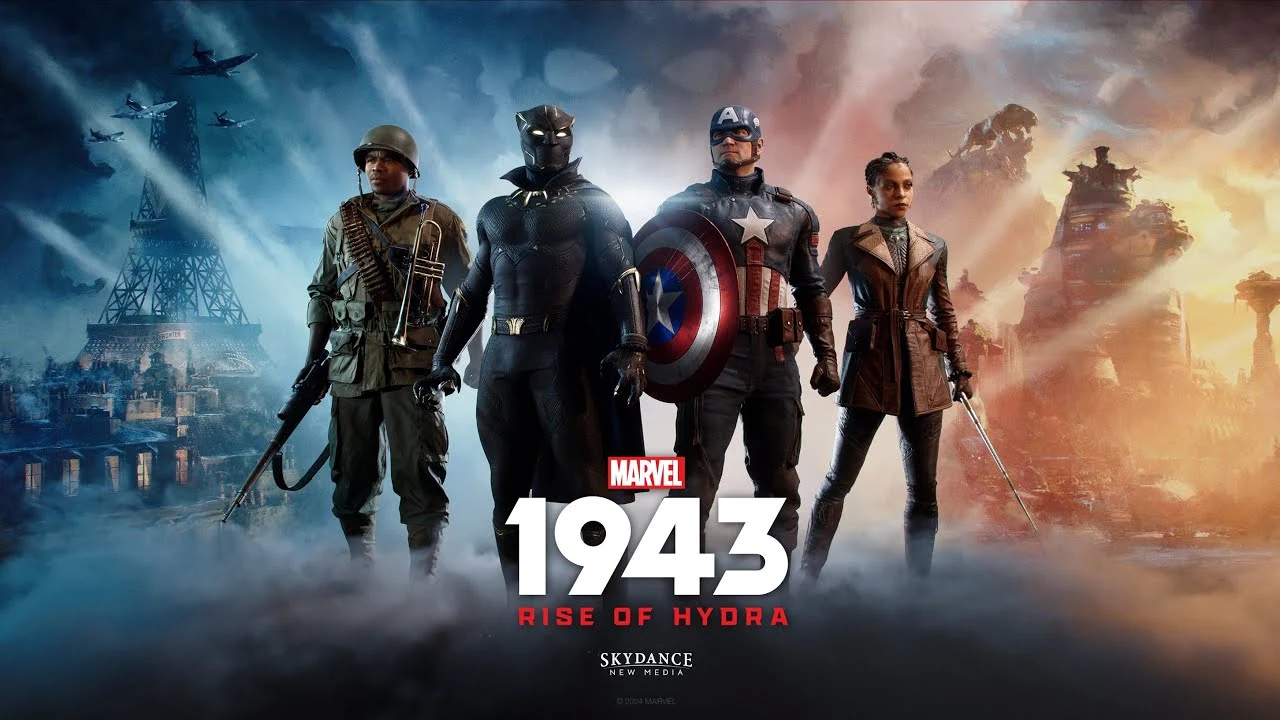
- Marvel 1943 Rise of Hydra Unreal Engine 5 tech runs on UE 5.4, showcased in a real-time bridge demo.
- Nanite adaptive tessellation generates dense 1940s Paris geometry with efficient memory use.
- MetaHuman Animator preserves actor facial performances for Captain America and Black Panther.
- Heterogeneous volumes deliver film-quality smoke and fire reacting to dynamic lighting.
- ML cloth simulation trained in Houdini creates realistic leather deformation in real time.
Marvel 1943 Rise of Hydra Unreal Engine 5 Overview
Marvel 1943 Rise of Hydra Unreal Engine 5 technology represents one of the most ambitious uses of Epic's UE 5.4 toolset in a narrative action game. Set in 1940s occupied Paris during World War II, the game follows Captain America and a new Black Panther (Azzuri) as they clash and cooperate against Hydra's rising influence. The development team built a real-time demonstration that runs the game's bridge confrontation scene — Cap and the Panther squaring off while Nazi patrols sweep the city — entirely in engine, with no pre-rendered shortcuts.
Video Highlights:
- Real-time bridge scene with Captain America and Azzuri's Black Panther in occupied Paris
- Nanite adaptive tessellation turning simple ground planes into dense, displaced geometry
- Heterogeneous volumetric smoke and fire casting shadows in real time
- MetaHuman Animator facial capture from actors Drew Moerlein and Khary Payton
The core philosophy is harmony between characters and environments: believable heroes demand equally convincing, densely detailed worlds. Every rooftop, prop, and snow-covered street in the winter Paris setting is built to support that goal.
| Demo Element | UE 5.4 Feature | Result |
|---|---|---|
| Winter Paris streets | Nanite adaptive tessellation | Dense ground detail from simple geometry |
| Snow-covered props | Runtime displacement layers | Dynamically adjustable snow accumulation |
| Fire barrel smoke | Heterogeneous volumes | Volumetric smoke that casts shadows |
| Cap's leather uniform | ML deformation from Houdini data | Film-quality cloth in real time |
| Facial close-ups | MetaHuman Animator | Actor performances preserved faithfully |
The bridge demo runs entirely in real time. That means the lighting, shadows, deformation, and facial animation you see are gameplay-grade rendering, not offline cinematics — a strong signal for how the final game may look on capable hardware.
Nanite Adaptive Tessellation: Building 1940s Paris
Traditional Nanite workflows stream pre-built mesh detail, which can become impractical across a huge open level. UE 5.4's adaptive tessellation attacks this from a different angle.
Start Simple
Artists author a relatively simple ground plane — the demo shows a surface made of just a few hundred triangles.
Layer Tile Textures
Layered tile textures combined with shader logic drive the displacement, rather than heavy authored geometry.
Displace Dynamically
The engine generates new three-dimensional geometry at runtime, matching Nanite-level detail without massive memory cost.
Change at Runtime
Because tessellation is dynamic, effects like footprints and tire tracks can be visualized directly in the geometry.
The same technique extends beyond terrain. In the demo, the team dials snow accumulation up and down on a pile of objects and rooftop props, blanketing the scene in believable winter coverage — all rendered as actual geometry, not decals.
The developers emphasized that tools like these empower even a small team to art-direct and set-dress environments dynamically, building complexity layer by layer.
| Technique | Old Approach | UE 5.4 Approach |
|---|---|---|
| Ground detail | Heavy instanced meshes | Shader-driven displacement |
| Memory cost | Can become impractical | Efficient across large levels |
| Snow on props | Hand-placed or decals | Runtime dial-up/down geometry |
| Surface interaction | Static | Footprints, tire tracks possible |
Heterogeneous Volumes and Lighting
Fire and smoke are where Marvel 1943's occupied Paris earns its grit. Past games faked these effects with particle sprites — flat cards that break down under scrutiny. UE 5.4 heterogeneous volumes replace the cheat with true volumetric simulation.
Volumetric Smoke
- Smoke casts shadows on the world and itself
- Fire glow transmits through the volume
- Fully responsive to dynamic lighting
Unified Effects
- Mixes with traditional particles and cards
- Simulation runs natively in Unreal Engine
- OpenVDB import via sparse volume textures
Film-Quality Result
- Volumetric VFX running in real time
- No pre-baked lighting shortcuts
- Matches cinematic rendering standards
The watchtower fire barrel scene is the showcase: light a barrel, illuminate the smoke, and watch volumetric shadows and light transmission behave as they would in a film render — but interactive.
Heterogeneous volumes mean atmosphere is no longer "nice from afar, far from nice." Fog, smoke, and fire participate in the lighting simulation itself.
Characters: MetaHumans, ML Cloth, and Performance Capture
An authentic Marvel hero needs a costume that behaves like real material. Captain America's leather uniform fits and creases exactly as leather should, thanks to machine learning deformation: complex cloth simulations run in Houdini offline, the data trains an ML model, and that model produces film-quality deformation in real time inside the engine.
Facial performance gets equal treatment. Black Panther's unmasked scene showcases MetaHuman Animator — untouched solver output that retains every nuance of Khary Payton's performance as Azzuri. The same pipeline honors Drew Moerlein's Captain America.
| Character | Actor | Tech Pipeline | Highlight |
|---|---|---|---|
| Captain America | Drew Moerlein | ML cloth deformation + MetaHuman | Leather uniform creasing in motion |
| Black Panther (Azzuri) | Khary Payton | MetaHuman Animator facial capture | Untouched solver facial detail |
| Both | Full cast | Real-time bridge scene | Entire confrontation runs in engine |
The bridge scene dialogue — "I do not take orders from anyone" — plays out with the Panther's mask off specifically to demonstrate what the combined pipeline achieves when talent and technology merge.
Tech demos are built to showcase engine capability. Final in-game results may vary by platform, settings, and development changes before release.
What to Watch For and Checklist
For fans tracking Marvel 1943 Rise of Hydra's development, the UE 5.4 demo reveals clear pillars the team is investing in. Use this checklist to evaluate future trailers and gameplay reveals against the demo's standards.
Tech Demo Benchmarks:
- Real-time rendering (no pre-rendered cinematics)
- Dynamic surface deformation (footprints, snow)
- Volumetric smoke and fire with shadow casting
- MetaHuman facial fidelity in close-ups
- ML cloth deformation on hero costumes
| Pillar | Demo Evidence | Why Fans Care |
|---|---|---|
| Immersion | Believable occupied Paris | Story set in 1943 WWII France |
| Character fidelity | Two-actor capture pipeline | Heroes must match world realism |
| Scalability | Memory-efficient tessellation | Large detailed levels feasible |
| Cinematics | Real-time bridge scene | Story moments playable at quality |
Rewatch the demo in 4K and pause on the triangle view moments — seeing the simple base geometry transform into Nanite-quality detail is the clearest illustration of what UE 5.4 changes.
FAQ
Q: Which Unreal Engine version does Marvel 1943 Rise of Hydra use?
The tech demo is built on Unreal Engine 5.4, featuring Nanite adaptive tessellation, heterogeneous volumes, and MetaHuman Animator. The demonstration runs entirely in real time.
Q: Who plays Captain America and Black Panther in the game?
Drew Moerlein plays Captain America, and Khary Payton voices Azzuri, the era's Black Panther. Their facial performances are captured and translated through the MetaHuman pipeline.
Q: What is Nanite adaptive tessellation in simple terms?
It takes simple geometry and displaces it at runtime using layered tile textures and shader logic, producing Nanite-level detail with far lower memory requirements. It also enables dynamic effects like footprints and tire tracks.
Q: Was the bridge scene pre-rendered?
No. The developers explicitly state the bridge confrontation between Captain America and Black Panther runs entirely in real time, including lighting, smoke, cloth, and facial animation.